Showing posts with label heritage building. Show all posts

Jan 24, 2013

Visit the Old Istana Negara

Finally we get to glimpse how the Royal Agung (King) in Malaysia live in the former Istana Negara now that they plan to turn it into a museum. Most of the time we only get to view the gates and the changing of the guards. And if you crane your neck and try to look through the bush you can see the royal palace facade.

Now that the King has relocated to their new residence in the Jalan Duta area, the old Istana Negara could finally be open to the public! It would be great to have a walk through and view the grand interior! However I wonder if the public would be allowed to snap photos. A few of the royal museums that I visited did not allow the public to take pictures, which was such a crying shame.

Anyway, in order to entice the public to come visit the royal palace, here are some photos from the local dailies giving you a rare glimpse on the inside interior of the old former Istana Negara!

Sep 23, 2012

Terrapuri Heritage Village, Penarik, Terengganu

Terengganu has always been a favourite seaside getaway for me. It has the most beautiful white sand beach with shallow seas in the Peninsular Malaysia. If not for its distance I would be frequenting Terengganu state for my tourism and travel! And now there is this Terrapuri Heritage Village at Penarik giving you a unique experience on cultural and heritage holiday stay! From this info, looks like a good way to give it a try too!

Terrapuri celebrates Terengganu's rich architectural and cultural heritage
Story and pictures by Andrew Sia
Monday September 24, 2012


Terrapuri is no ordinary conservation and restoration project. It celebrates the rich architectural and cultural heritage of Terengganu

A Chinese businessman has been collecting antique Malay houses for 20 years, and he has now turned them into a lovely heritage-themed boutique resort called Terrapuri, which means The Lan d of Palaces.

The location he has chosen is Penarik, an hour's drive north of Kuala Terengganu. This stunning site sits on a narrow spit of land sandwiched between a riv er lined with nipah sugar palms and the glistening sea graced by gently swaying coconut trees, all capturing the windy whispers from the South China Sea.

Serene: View of the pool at Terrapuri and the surrounding wetlands.

Just off-shore lie the island jewels of Pulau Redang, Pulau Lang Tengah and Pulau Bidong, each graced with necklaces of liquid gemstone in the form of luminous aquamarine waters.

The intrepid collector is Alex Lee Yun Ping, 44, a self-made entrepreneur who runs the state's largest tour company, Ping Anchorage Travel & Tours. Now he has created a little slice of paradise with 29 aged Terengganu ho uses which have been transformed into luxurious villas, as well as a spa, Malay restaurant, meeting centre, reception, library and art gallery.

Such is the weight of architectural treasure here that Terrapuri has been used to shoot the Malaysia Truly Asia advertisement, as well as the Malay epic film Hikayat Merong Mahawangsa. But this is certainly no ordinary conservation and restoration project. Rather, it's meant as a model living heritage used and enjoyed by guests every day.

The villas have many of the modern comforts one expects – air-conditioning, hot showers, mini fridge, kettle, etc – amidst a setting of real antiques such as woode n gerobok (cupboards), brass trays, earthen jars and wooden chests. I choose to switch off t he air-con and open the carved wooden windows, the better to feel the sea breeze from the nearby beach, while safely protected from mosquitoes inside my kelambu (mosquito net) over the bed.

Alex Lee prying open some live oysters as pre-dinner appetiser on a floating fish farm near Terrapuri.
Alex Lee prying open some live oysters
as pre-dinner appetiser on a floating
fish farm near Terrapuri.

Traditional Malay ho uses have a rumah dapur, the wet part of the house which is usually a bit lower than the main house. At Terrapuri, this has been cleverly transformed into a large and luxurious bathroom complete with a wooden bathtub. This is precisely where I opt to dissolve the stress I have carried over from KL.

Alex, as he prefers to be known, is an antique collector who just happens to gather whole houses! This has been possible not only because traditional Terengganu homes are made of extremely durable cengal wood but, more importantly, because they can be dismantled and reassembled.

"Not a single nail is used to build the houses, " he explains. "Instead, the beams are fitted together using pasak (wooden pegs). Even the walls are made of timber panels slotted into grooves (in the beams)." (You can see this being done in the iSnap video).

This portability has enabled him to scour the state looking for time-honoured homes, some with colourful stories. Take the t wo grand houses named Teluk Pasu and Teluk Rusa. They were built 150 years ago by one Haji Mohd Ali, a 19th century rags-to-riches merchant who made his fortune from making pelara (fish fermented with salt to make a sauce) along the coast and then sending boats upriver to barter it with rice, fruits, and other jungle produce. Now the twain are in the process of being converted into the resort's library and art gallery respectively.

It was back in 1988, after Alex had just turned part of his grandparents' wooden shop in Marang (a small town 20km south of the state capital) into a backpackers' inn, that his foreign guests began influencing him to better value local culture, arts and architecture.

"In those days, we Asians did not appreciate our own things much. Old wooden houses were allowed to rot away," he recalls.

Unfortunately, this included the state authorities which decided to demolish Marang's "old and ugly" wooden shops in the early 1990s to make way for "development" with new concrete structures. The backpackers simply stopped coming to what used to be one of the must-stop destinations along the East Coast.

But Alex saw the value of these age-old structures and bought whole kampung houses, some for merely RM7,000 to RM10,000 each, as well as an array of wooden antiques such as coconut husk scrapers, looms, ploughs, carpentry tools and carvings (some of which are on display at Terrapuri).
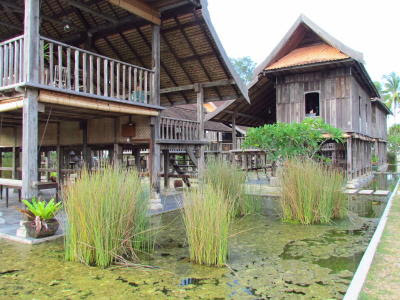
A cluster of antique Malay houses have been turned into a fabulous heritagethemed boutique resort called Terrapuri, which means The Land Of Palaces, at Penarik, Terengganu.
A cluster of antique Malay houses have been turned into a
fabulous heritage themed boutique resort called Terrapuri,
which means The Land Of Palaces, at Penarik, Terengganu.

He even bought half-decayed houses for the valuable cengal wood could be used as spare parts for his resort.

The classic Terengganu house, known as Rumah Bujang is built on stilts, has a steep roof, gent ly curved gable ends and rhomboidshaped terracotta roof tiles.

The level of conservation detail here can be seen with the intriguing white, red and black cloths placed at the top of several main house pillars ( which the roof beams rest on). These are the bunga halang charms which have azimat or special writings on them to ward off bad luck.

While the physical houses themselves may be over a hundred years old, they represent a much more ancient Malay culture. Alex cites the book Spirit Of Wood: The Art Of Malay Woodcarving by Dr Faris h A. Noor and Eddin Khoo, which postulates that Terengganu is heir to the rich cultural legacy of the ancient Langkasuka kingdom (2nd to the 16th century CE) which had trade and cultural links to Cambodia, Thailand, Champa (Vietnam) and Java besides China and India.

The traditional rumah dapur (kitchen) has been cleverly transformed into a luxurious bathroom complete with wooden bathtub.
The traditional rumah dapur (kitchen) has been
cleverly transformed into a luxurious bathroom
complete with wooden bathtub.

"Malay civilisation was here even before Malacca," says Alex.

The Terrapuri project has had perhaps a more powerful knock-on effect on heritage a wareness than any seminar.

"People can now see the (monetary) value of their old houses," says Alex. "From RM10,000 about 20 years ago, an old house can now sell for RM50,000. So, nowadays, you see people keeping their old wooden homes next to their modern concrete ones."

The whole undertaking has cost him some RM10mil so far. Some of his friends called it projek orang gila (mad man's project), while his accountant kept te lling him there is little return on investment, especially with the slump in the number of European visitors due to the economic problems there. But he kept ploughing on, raising money from different quarters, even selling his Mercedes.

"For RM10mil, I could have bought five shophouses and turned them into a midrange hotel as a cash cow. My wife has also been complaining and asking why I want to suffer. But it's not just about the money. I am passionate about these old houses. They are masterpieces."

Indeed when so many places in South-East Asia offer beaches and islands, Terengganu needs an extra edge to bring in tourists and Alex believes heritage is the key.

"We face stiff competition from Thailand and Bali where cultural tourism is stronger," he notes.

Despite having applied for financial assistance from the relevant authorities for his work in preserving heritage, nothing has been forthcoming.

---> Terrapuri Heritage Village is located in Kampung Mangkuk, Penarik, 22120 Setiu, Terengganu (09-624 5020 / e-mail: info@terrapuri.com / website: terrapuri.com).

---

Preserving Terengganu's botanical and culinary heritage
By Andrew Sia
Monday September 24, 2012


An oasis of luxurious kampung living, Terrapuri also aims to preserve Terengganu's botanical and culinary heritage.

APART from the hardware of the homes themselves, the Terrapuri project is also keeping alive the crucial software of carpentry skills needed to maintain heritage homes.

Alwee Abd Rahman, 44, the resident maintenance manager, has been a carpenter since he was 13, following in the footsteps of his father Abd Rahman Abdullah.

Homely touch: The service is warm at Terrapuri, and you can even enjoy breakfast on the verandah.
Homely touch: The service is warm at Terrapuri,
and you can even enjoy breakfast on the verandah.

"My father and grandfather were wood workers who made boats and houses," he says. "I learnt much from them, for instance, how to use wooden pegs instead of nails when joining wood together."

His son Alhuzaifi Alwee, 20, is, in turn, following his footsteps as an apprentice.

"As most of the kampung folks now want concrete houses, the old skills of traditional builders are being lost," says self-made entrepreneur Alex Lee Yun Ping. "Yet conservation can become a whole industry in its own right, like in Europe."

Alwee is not just preserving the past but also innovating new products. The anthology of antiques here includes many traditional Malay beds which are sized somewhere between today's Queen- and single-sized beds (requiring special mattresses to be commissioned for them).

The founder of Terrapuri, Alex (as he prefers to be called), says that since there were many more beds than needed at the resort, he discussed with Alwee how to turn some of them into benches.
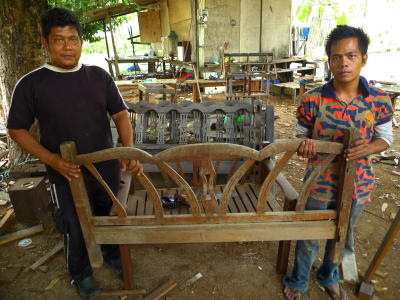
An antique bed which is being converted into a bench. Alwee Abd Rahman (left) and his son Alhuzaifi Alwee are maintaining their family's living heritage of carpentry skills.
An antique bed which is being converted into a bench.
Alwee Abd Rahman (left) and his son Alhuzaifi Alwee
are maintaining their family's living heritage of
carpentry skills.

"The resort could easily have just bought benches from Bali for RM400," says Alex. "But we wanted our own Terengganu identity. You won't see these benches anywhere else."

This is the place to experience kampung living in style. From breakfast on your villa's verandah with the classic Terengganu dish of nasi dagang (spicy sweet tuna curry with rice) to dinners of sup bujut (local chicken soup), ayam masak merah (tomato curry chicken) and budu (fermented anchovies) at the high Rumah Tanjung overlooking the pool and surrounding forest.

Instead of parachuting in some hotel managers from Kuala Lumpur, Alex has chosen the approach of "community-based tourism" to ensure that some income from visitors will flow towards people who live in or around Penarik. Thus tudung-clad village women provide a most homely welcome as they act as receptionists, serve food or do housekeeping, while chatting about your day's activities, or about life in Terengganu.

Food is also sourced from nearby villages, and a must-do day trip here is out to the nearby floating aquaculture farms in the river. Here, I watch Alex pulling up a whole slew of live oysters and prying them open for consumption on the spot!

The idyllic kampungs around the resort are great for cycling, and I see fishing boats, orchards, a turtle hatchery and even a breeder of ornamental cockerels known as ayam serama. In fact, the Setiu Wetlands surrounding Penarik offer a host of eco-tourism delights, including trips out to the nipah and mangrove swamps. An even more magical experience awaits me at night as fireflies on the mangroves create flashing dots of light…

Penarik is just 20 minutes from Merang jetty, the jumping-off point for day trips to the islands of Pulau Redang, Pulau Lang Tengah and Pulau Bidong. There's nothing like some snorkelling to work up an appetite!

But for something more unusual, I visit the haunting gelam forests around the resort. Alex says the movie Bunohan was filmed here, and it's easy to see why because the trees exude a mysterious charm with their gnarled barks, spindly branches and draping leaves.

Indeed, it's not just architecture that is being preserved here, but also the state's botanical (and culinary) heritage. Alex is working to create a rich garden of herbs – such as kadok leaves (used for otak otak), kelsom (laksa), ulam (salads) pandan, lemongrass, ginger, galangal, turmeric, bunga kantan (all used in curries) and the aphrodisiac tongkat ali.

The idyllic kampungs around the resort are great for cycling, and you can see fishing boats, orchards, a turtle hatchery and even ornamental cockerels.
The idyllic kampungs around the resort are great for cycling,
and you can see fishing boats, orchards, a turtle hatchery
and even ornamental cockerels.

Apart from the normal mango and soursop, he is also planting more "kampung" trees such as sukon (breadfruit), kerkut (which has small cherries that attract birds), cermai and gajus (both can be mixed with belacan into a condiment) and melinjau (used to make a type of local crackers). Meanwhile, the flowers from frangipani, cempaka, melor, kenanga, gardenia and kesidang trees will (once the trees mature) impart a bouquet of natural fragrances.

The wetlands on one side of the resort are rich with jambu laut, gelang, pandan laut, paku laut (cycads rumpii), kerecut reeds (which can be weaved into mats) and, of course, nipah (the leaves are used for attap roofs). And if you ever wondered what inspired Terengganu's woodcarvers to create their gloriously intricate patterns, look no further than the surrounding plants such as pepulut, sesayap, ketam guri, bayan peraksi, bakawali, kangkong and ketumbit. Yes, the plants here can be eaten, and even inspire art, too!

Indeed, it's heartening that heritage at Terrapuri is being celebrated on a deeper level beyond architecture, by delving into ancient carpentry, traditional cooking, pristine wetlands and a rich botanical inheritance.

Source: The Star Lifestyle

Terrapuri Heritage Village at Penarik, Terengganu

Jun 18, 2012

Visit Central Market Pasar Seni for Cultural Souvenirs

Central Market or Pasar Seni is the place to go to hunt down some souvenirs for your holiday travel. Located in the heart of KL, easily accessible via the Pasar Seni LRT station, it is one of the favourite haunt for visitors looking for something special to bring home with them.

Central Market Pasar Seni Exterior has been upgraded. It is also a great place to look for souvenirs

This used to be a wet market selling perishable household food stuff and smelly fish and all. Being located in the prime location of Kuala Lumpur it was also causing much congestion. So City Hall decided to relocate the wet market activities elsewhere and refurbish the place as a cultural art souvenir center. They didn't want to demolished it as it has a long historical significance so converting it as tourism attraction place was a good move.

So come on over here and see if you can find some interesting artifact as a souvenir for your vacation trip!

Central Market is still the place for souvenirs, artefacts and cultural activities
By Jayagandi Jayraj
Photos by Mohd Faihan
Monday June 18, 2012

THE Central Market in Kuala Lumpur has always been a treasure trove of all things Malaysians, although recently it has extended itself to feature some foreign items too.

Complex manager Cheong Wai Mun said Central Market was a place focused on local artefacts, but there were also a small range of offerings which were not Malaysian.

“Most tenants here sell Malaysian-made items but other things which are not local are sold to complement what we have and also to offer a variety for tourists and visitors.

“For example, on the upper floor, we have the batik emporium selling batik that is produced here. But along with it, there are also some varieties from the neighbouring countries,” said Cheong at an interview recently.

Upgraded: A view of the kiosks at Central Market.

The 124-year-old Central Market, whose long history is intricately connected to the old and new generations of Kuala Lumpur is a testament that old buildings could be preserved and transformed to make it relevant with present times.

Since the takeover by Kha Seng Group in 2004, the place has been given a facelift to promote its unique selling point as an outstanding centre for Malaysian art and handicraft.

A RM10mil investment meant many positive additions to the building including zoned shopping areas and upgraded kiosks and stalls, creating a net lettable area estimated at over 650sq m of retail space.

The zoned areas reflect the cultural diversity of Malaysia with streets like Lorong Melayu, Cina and India.

Lorong Kelapa is a lane that offers traditional Malay snacks while Malacca Jonker Street is a comprehensive shopping centre for Malaysian handicrafts art.

Some of the local shops include the Coconut Shop which offers various souvenirs and artworks made from coconut shells and the Asli Kraf centre offers a wide variety of locally-made woven goods from materials which are found in the local forests.

Almost lifelike: Abdul Hadi Ahmad, whose shop is at the Annex is well known for his portraits of politicians.
Almost lifelike: Abdul Hadi Ahmad,
whose shop is at the Annex is well known
for his portraits of politicians.

Its owner Pong Panjang said the handiworks were sourced from the various orang asli communities in Terengganu, Pahang, Selangor and Perak.

The materials used for the handiworks are from various plants such as mengkuang, bamboo, bemban, kerdut and ribu- ribu.

Pong said ribu-ribu, which was a type of fern usually found in Sabah, was rare and a certain dexterity and expertise was required when weaving it.

“Since it is quite difficult to handle ribu-ribu, some use rattan instead. Ribu-ribu goods are often more expensive compared to others,” explained Pong, who has been operating in Central Market since the 80s.

Like Pong, there are many long-time tenants who trade at the Central Market. They include Songket Sutera operator Badrul Muda and artist Abdul Hadi Ahmad, whose shops are at the Annex, behind the main building.

While the tenants are happy and sure that they would be allowed to run business there as long as they want to, their competitors are shopping complexes mushrooming everywhere.

Tasty treat: This putu bambu shop is popular among the Central Market visitors.
Tasty treat: This putu bambu shop
is popular among the Central Market visitors.

“Those days, there were only a few places like the Pertama Complex and Central Market as shopping attractions for people, but nowadays visitors have more choices. We are not getting as many visitors as we used to,” said Badrul.

According to Cheong, they have been organising more events to highlight Central Market as a cultural hub. She said many cultural activities were carried out at the venue apart from observing the major celebrations. A big attraction is the Lantern Festival, where visitors are given lanterns before a procession.

“We also have cultural dances from Monday to Thursday, and something on every day. On Sundays, we have martial art performances, which is quite popular among visitors here,” she added.

For detail on activities at the Central Market, visit www.centralmarket.com.my -- StarMetro

The Jonker Street in Central Market is modelled after the one in Melaka, looked real authentic!
The Jonker Street in Central Market
is modelled after the one in Melaka,
looked real authentic!

Apr 16, 2012

Penang Wayfinding System to visit Heritage sites

Having good signage is a must for tourism Malaysia. So the new Wayfinding System in Penang should help travelers find their way around the various historical and heritage sites around Georgetown.

Pointing the way to heritage gems
By Han Kar Kay
Friday April 13, 2012
Photos by Lim Beng Tatt


THE newly-launched Wayfinding system in Penang should provide an innovative approach for tourists during their visit to historical sites along the island’s famous Jalan Masjid Kapitan Keling.

The pilot project, an initiative by Think City Sdn Bhd (TCSB) together with George Town World Heritage Incorporated (GTWHI) and the Penang Municipal Council, is designed to provide information on the 10 heritage sites.

GTWHI acting general manager Lim Chooi Ping said the project that cost RM167,000 kicked off end 2010.

"The first phase saw installations of seven directional signs, four maps, and 12 site panels with descriptive information.

"The 10 sites include Kapitan Keling Mosque, Han Jiang Ancestral Temple, Khoo Kongsi, Yap Kongsi, Logan Memorial, St George’s Church, Goddess of Mercy Temple, High Court, Sri Maha Mariamman and Acheen Street Malay Mosque.

"So far, we have identified other sites such as Weld Quay, Little India and Beach Street for the second phase," she said at GTWHI office in Acheh Street, Penang, on Monday.

TCSB chairman Prof Datuk Dr Anwar Fazal said the signs installed at various historical sites would give directions to tourists in Penang.

Penang wayfinding system for tourist
American tourist, Carolyn Fowle and Melissa Perham
looking at the newly installed maps found along
Jalan Masjid Kapitan Keling.


"We welcome more ideas for improvement in the next phase," he said.

Penang Chief Minister Lim Guan Eng, who officiated the event, visited several sites such as Kapitan Keling Mosque, Khoo Kongsi and Yap Kongsi.

He said this was the first initiative based on the "public-private partnership" concept between the state government and other stakeholders.

Jul 29, 2011

Central Market Pasar Seni KL

Central Market or Pasar Seni is one of the popular tourist destination in Kuala Lumpur. It can be reached via the Pasar Seni LRT station. I still remember the time when it was converted from a wet market to its current art and craft market when I was a school boy studying nearby. It is still a draw for tourist now and with many activities and busking giving this place a very lively attraction.

Central Market or Pasar Seni, Kuala Lumpur
Central Market / Pasar Seni, Kuala Lumpur

Central Market: Keeping heritage relevant
By Anansa Jacob
29 July 2011


THE Central Market has been a Malaysian cultural focal point for many tourists visiting Kuala Lumpur, but these days, few city folk actually visit the 123-year-old landmark themselves.

In 2004, Central Market was taken over by Kha Seng Group, which also runs other key building projects like Viva Home and the upcoming Kenanga Wholesale City.

Since then, this tourist hub has been revamped, with new facilities and additions to emphasise its status as a showcase for Malaysian arts and handicraft.

The efforts to improve Central Market have paid off with the place earning an Excellence award at the Kuala Lumpur Mayor's Tourism Awards in June.

At a recently organised media tour, Kha Seng Group public relations executive Julia Emmanuel gave a group of journalists and bloggers a firsthand look at the new Central Market.

"One of the most obvious additions is the Kasturi Walk, located next to Central Market," she said. "We built a covered roof over the various kiosks that sell food and souvenirs over the sidewalk, and gave it a local touch with giant wau bulan structures located at both ends."

Kasturi Walk is also a venue for nightly cultural performances, as well as a Cuti-Cuti 1Malaysia dance performance every Saturday night.

Within Central Market itself, where tourists can purchase unique souvenirs and traditional handicrafts, it looks as though not much has changed. But upon exploration, the layout of the shops are better organised, with handicrafts from specific cultures organised into 'streets' such as Malay Street, Straits Chinese, Little India, Jonker Street and Blue Mansion.

There are also several new eateries there, most of them selling popular versions of local cuisine. These include Oldtown White Coffee, Ginger Restaurant, Annexe Nasi Kandar and Rainforest Bistro & Restaurant. There is also a food court located on the upper floor for those looking for a more varied F&B experience.

The Central Market Annexe, located behind the main building, has also been revived as a space for the local art scene, with galleries and an area for performances or events.

There is also a daily free Heritage Walk tour, organised by Be Tourist. The tour guides are all volunteers, and they take interested visitors on a leisurely walk through areas in the city that showcase local Malay, Indian and Chinese cultures.

Our tour guide that morning was Connie, who was chirpy despite the wet weather we were having that day. She explained the history of Central Market, telling how it had evolved from its humble origins as a wet market in 1888 to its current incarnation.

After that, she took us on a roundabout trip through parts of old Kuala Lumpur and Masjid Lebuh Ampang. Our first stop was the century-old Masjid Jamek, which overlooked the confluence of the Gombak and Klang rivers. The historic mosque usually opens its doors to visitors, who are allowed to walk in and take photographs.

Later, we arrived at Little India to visit a chettiar building, one of the last few traditional moneylenders in the city. After that, we were taken through a narrow alley which housed three stalls manned by owners from the three main races in Malaysia. According to Connie, because of this, the place was known as the 1Malaysia Food Street.

We also visited the Sin Sze Ya temple, a Taoist temple that was built by the city founder Kapitan Yap Ah Loy in 1864, and is still visited by those wanting blessings and guidance for themselves or their families.

Throughout the journey, Connie also pointed out several old buildings that had historical value, including the city's oldest pawnshop, as well as a building with a balcony where she said maidens used to choose their husbands by throwing handkerchiefs for prospective suitors to catch.

Sadly, she added, most of these buildings were run down and not well cared for, and like many other historical sites, had been overlooked or sacrificed for the sake of rapid development.

Later, over lunch in Precious Old China, a restaurant serving fusion nyonya cuisine on Central Market's first floor, Julia said that there were more events planned at Central Market to reintroduce it to Malaysians.

"Everyone knows that it is a tourist destination, but we also want Malaysians to come and visit it," she said.

Among the activities planned are a photo contest to capture the essence of Central Market, a postcard-making workshop and a Chinese Opera performance in August. Not to mention the various cultural performances every day.

"We want people to come and visit Central Market and just see how much things have changed over the years," Julia added. "We want them to come and maybe even learn something new about the different cultures in their own country, and by teaching the public, we hope to be able to keep our heritage alive for many generations to come."

Source: thesundaily.my/news/94300
Find out more Info: centralmarket.com.my

It's been a long while since my last visit to Central Market Pasar Seni. Good for revisit for us locals too!

Jul 9, 2011

Ipoh Heritage Walk

Walking down history lane
Saturday July 9, 2011
By Anthony Law


THE Ipoh Heritage Walk has proven to be so successful in creating awareness of the city’s tourism potential that groups from other states have flocked to Perak to learn its ways.

Majestic: The grand exterior of the Ipoh Railway Station.

Tourism Malaysia and Penang Heritage Trust were among the groups impressed by the success of Ipoh Heritage Walk project since it was introduced last May. The two groups made a special trip to Ipoh recently.

Tourism Malaysia had earlier participated in a food trail to taste the best of Ipoh food, before taking part in the heritage trail proper.

Most of the walkabout takes place in Ipoh Old Town, to showcase its rich heritage and architecturally beautiful buildings.

May 28, 2011

Ipoh Railway Station - The Old Dame

Ipoh Railway station sees more activity thanks to new train service
By Chan Li Leen
Friday May 27, 2011


ONCE in danger of becoming a white elephant, the Ipoh railway station has experienced a revival recently.

It has slowly regained its popularity with the introduction of the Electric Train Service (ETS) on Aug 12 last year, travelling between Ipoh and Kuala Lumpur.

Now, the station is abuzz with activity.

ETS chief operating officer Azizullah Kinayatullah said the train services ran 10 times daily including weekends.

In use: The exterior of the Ipoh Railway Station.