Showing posts with label unesco. Show all posts

Oct 22, 2011

Cheong Fatt Tze Building aka The Blue Mansion in Penang

Here's an interesting place to visit, the Cheong Fatt Tze Building aka The Blue Mansion in Penang. Look for it when you next visit Georgetown Penang and see what it is all about!

Cheong Fatt Tze building is one of two in Asia featured on Lonely Planet list
By Andrea Filmer and Fong Kee Soon
Saturday October 22, 2011


George Town: The Cheong Fatt Tze Mansion (aka the Blue Mansion) here has been named one of the world's top 10 greatest mansions and grand houses by popular travel guide Lonely Planet.

The grand dwelling, often dubbed the Blue Mansion due to its vivid colour, is one of only two buildings in Asia to make the list.

The other is the Marble Palace mansion in Kolkata, India.

Others that made the list include the Villa d'Este in Italy, England's Castle Howard that provided the backdrop for the television and cinema adaptation of Brideshead Revisted, famed 16th-century Chateau de Chambord in France and the Catherine Palace in Russia.

The United States was the only country with two venues making the list Fallingwater in the woods of Pennsylvania and Beauport House in Massachusetts while Australia and Ireland rounded up the grandest homes list with Werribee Mansion in Melbourne and the 13th-century Powerscourt Estate in the Wicklow Mountains respectively.
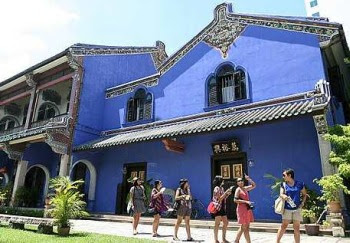
True blue: The Cheong Fatt Tze Mansion in Penang. The historical structure was also featured as the title picture for the Lonely Planet list.
True blue: The Cheong Fatt Tze Mansion in Penang.
The historical structure was also featured as
the title picture for the Lonely Planet list.

The Lonely Planet list was reprinted last Sunday by the Fox News website, which chose the Blue Mansion as its story's main picture.

This latest accreditation follows several other prestigious awards already given to the mansion, including a Unesco “Most Excellent” Heritage Conservation Award in 2000, an Asean Tourism Association Excellence Award for Best Asean Cultural Preservation Effort in 2004 and the Malaysian National Architectural Award For Conservation in 1995.

The mansion was built in the late 19th- century by Cheong Fatt Tze, a self-made wealthy Chinese merchant.

Loh-Lim Lin Lee, who bought and restored the dwelling with husband Laurence Loh in the late 1980s to 1990s, said the mansion received some 2,000 visitors every month. -- The Star Nation

Oct 8, 2011

Gunung Mulu National Park - Best caves tourism destination

If you like caving, head on to Gunung Mulu National Park as they are considered one of the best caves to go spelunking. While you are there, don't forget to explore other areas of the national park and climb up and view the breath taking 'Pinnacles' and of course enjoy the nature of the tropical rainforest of Sarawak.

Don't forget to try the world's longest canopy walk at the National Park too, ya?

Best caving destination
Saturday October 8, 2011

Dubbed the “most spectacular caves on earth” by international cave experts, Gunung Mulu National Park is unsurprisingly picked as the best caving destination by speleologist and freelance journalist Liz Price.

Kuala Lumpur-based Price has been caving in South-East Asia for more than 20 years.

One of the spectacular caves at Mulu National Park that draws visitors from all over the world.

With one of the longest networks of caves in the world, the Unesco World Heritage site is bestowed with a long list of superlatives. It houses the world’s largest underground chamber – apparently, you can squeeze in 40 Boeing 747 airplanes in the Sarawak Chamber.

The world’s biggest cave passage, the Deer Cave can fit cathedrals the size of Saint Paul’s in London and is where you can watch millions of bats swarming out at dusk. Then there’s Clearwater Cave, the longest cave in South-East Asia.

“Many caves have spectacular formations and are home to a wide variety of cave fauna,” says Price.

The adventurous can opt for adventure caving where you crawl, climb, scramble or squeeze through narrow cave passages while marvelling at the spectacular formations and creatures. -- The Star


Unique stromatolites in Deer Cave will encourage research
By Zora Chang
Tuesday July 26, 2011


The discovery of a unique type of freshwater stromatolite in Deer Cave at the Gunung Mulu National Park will open doors for research on the mineral deposits and exploration in other caves.

Researcher Prof Joyce Lundberg from the Department of Geography and Environmental Studies of Carleton University in Ottawa, Canada, said the stromatolites found near the northeastern entrance of the cave were the only sample of their kind in the world.

“It will also be a tourist attraction for Deer Cave, which is already famous for its huge passages and vast bat population,” she said at a public talk entitled “Freshwater Stromatolites in Deer Cave, Sarawak — A Unique Geobiological Cave Formation” here recently.

World’s first: Lundberg showing a piece of stromatolite during the talk at the Sarawak Museum.

The talk also featured Prof Donald A. McFarlane of Claremont Colleges in Claremont.

Lundberg said since these type of stromatolites were being studied for the first time in the world, there was no one who could say whether the mineral deposits had any medicinal value or if weather patterns had a hand in forming them.

Stromatolites are laminated, usually mounded sedimentary fossils formed by layers of cyanobacteria, calcium carbonate and trapped sediment.

They are present as horizontal shelves arranged in a series on a steep rock face that is vertically under a guano-laden shelf.

The rock face undergoes active dissolution from acidic guano drainage water and from aggressive rainwater from an overhead discharge.

It is corroded by the running water except for the parts protected by the stromatolites, creating a form-like tiny pillars or hoodoos.

The stromatolites grow upwards in annual laminae but are, at the same time, destroyed from underneath by biological corrosion and laterally by mechanical breakage.

A dynamic equilibrium is established between upward accretion of the fresh surface and destruction at the base such that the base of the stromatolite moves over time.

Therefore, over time they climb up the wall. -- The Star


Mulu walkway is longest ever at 480m
Monday July 25, 2005

MULU: The Mulu National Park has opened the world’s longest canopy skywalk, a 480m walkway suspended 20m above the forest floor.

Experts advised and helped the local communities design and build the structure.

The canopy skywalk is part of the Gunung Mulu world heritage area opened by Chief Minister Tan Sri Abdul Taib Mahmud yesterday.

Other facilities there include a plants-for-life trail, an 8km non-slip plank walk, radio communication systems, interpretive signage, renovated facilities at Camp 5, new public toilets and upgraded facilities for future on-site research.

Also built were new bridges, new park lighting and sensor-activated lighting in the four caves – the Clearwater, Wind, Deer and Lung Caves.

The Deer Cave boasts the world’s largest cave passage while the 107km Clearwater Cave is the longest in South-East Asia.

Mulu also has the world’s largest natural chamber – Sarawak Chamber – which can accommodate 40 Boeing 747 aircraft with room to spare.

The Mulu National Park has seen a significant increase in tourist numbers after it was made a Unesco world heritage site five years ago.

State national parks and nature reserves controller Datuk Cheong Ek Choon said the new facilities at Mulu Caves were fine examples of the private sector and government working together to promote eco-tourism and biodiversity conservation.

He said it was made possible through the joint efforts of Borsarmulu Park Management and Sarawak Forestry.

Cheong, also Sarawak Forestry managing director, commended the state's commitment to conserve more areas as national parks, nature reserves and wildlife sanctuaries, and its contribution to raise the profile of the Mulu National Park on the world stage. -- The Star

Sep 22, 2011

Lenggong Valley, Perak

Lenggong Valley in the limelight
By Sylvia Looi
Thursday September 22, 2011

PERAK'S bid to have the 50,000-year-old archaeological site of Lenggong Valley listed as an Unesco World Heritage Site looks promising with the recent visit by the organisation's valuer.

State senior executive councillor Datuk Hamidah Osman said the state government was confident of getting the site in Upper Perak into the organisation's list of cultural and natural heritage.

Vast area: A view of the Lenggong Valley where many undisturbed sites await archaeologists.

"A valuer from Unesco visited the site last Tuesday and it went very well. It will be a great boost to the state's tourism sector should Lenggong Valley be given the recognition as a World Heritage Site by Unesco," Hamidah told reporters at a press conference in Ipoh on Tuesday.

If successful, Lenggong Valley will become the fifth site in Malaysia to be listed as a world heritage site after Gunung Mulu National Park, Kinabalu Park and the cities of George Town and Malacca, which are listed as historic cities of the Straits of Malacca.

Hamidah, who is also state tourism committee chairman, said Lenggong Valley was the only paper submitted by Malaysia currently.

"The World Heritage Committee, which is made up of 21 members, will be vetting proposals submitted to it in June next year.

"Our Commissioner of Heritage, Prof Emeritus Datuk Zuraina Majid, will represent Malaysia in presenting our proposal then," she added.

Awesome site: A filepic of participants of the Perak Heritage Society's Lenggong Valley Trail admiring the cave where the skeleton of the famous Perak Man was found in Gua Gunung Runtoh.
Awesome site: A filepic of participants of the Perak Heritage Society's
Lenggong Valley Trail admiring the cave where the skeleton of the
famous Perak Man was found in Gua Gunung Runtoh.

Lenggong Valley is reportedly a jewel in Malaysia's archaeological crown.

Dubbed an "archaeologist's dream valley", the undisturbed site is said to have many more discoveries to be unearthed in years to come.

Excavations between 1987 and 1990 had revealed that Kota Tampan was a stone age workshop dating as early as 50,000 years ago.

It had also been discovered that there was a stone age community living around Lake Cenderoh.

Several other findings also had considerable impact on regional and world archaeology.

Old treasure: The Perak Man skeleton is being preserved with special care.
Old treasure: The Perak Man skeleton is
being preserved with special care.

Among them are the Perak Man, the only prehistoric skeleton in the world born with the congenital deformity Brachymesophalangia Type 2 in Gua Gunong Runtuh, Palaeolithic stone tool-making techniques in Kota Tampan, the migratory route of Homo sapiens from Asia to Australia, and the revelation that Southeast Asia was not the backwaters of civilisation as claimed by earlier archaeologists. -- The Star